Names & Legend
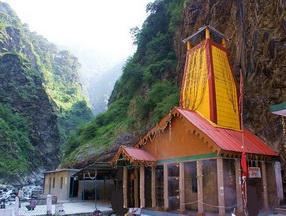
After the Ganga, the Yamuna is the most revered river of India, worshipped as Maa Yamuna – the divine mother who nourishes all who live along her banks. Yamunotri, the place where she begins her journey, is therefore one of the holiest pilgrimage sites in the Himalayas.
In the Puranas, Yamuna is the daughter of Surya, the Sun god, and the twin sister of Yama, the lord of death. It is believed that Yama promised his sister that anyone who bathes in her waters will be free from the fear of an untimely death. This bond between brother and sister is also remembered on Bhai Dooj (Yama Dwitiya), the day the temple closes for winter.
Location
Yamunotri lies in the Garhwal Himalayas of Uttarkashi district, Uttarakhand, at an altitude of about 3,293 metres. It is the first of the four shrines of the Chota Char Dham – Yamunotri, Gangotri, Kedarnath and Badrinath – and pilgrims traditionally begin their yatra here.
The true source of the river is the Champasar Glacier on Kalind Parvat, at a height of about 4,421 metres. Because the glacier is extremely difficult to reach and the weather is harsh, the shrine was built lower down the valley, where devotees can offer their prayers to the goddess.
The Temple
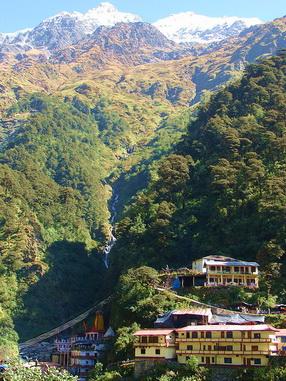
The present temple stands on the left bank of the Yamuna and was built by Maharaja Pratap Shah of Tehri Garhwal. The goddess is worshipped in the form of an idol carved from black stone, adorned with garlands and silver ornaments by the temple priests.
The temple opens each year on Akshaya Tritiya (April–May) and closes on Yama Dwitiya, the second day after Diwali (October–November). During the snow-bound winter months the goddess is carried in procession to the village of Kharsali, where she is worshipped until the shrine reopens.
Surya Kund & Divya Shila
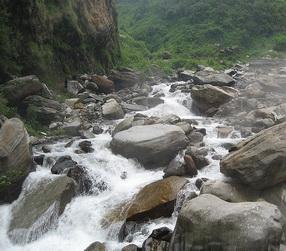
Close to the temple are several natural hot springs. The most important is Surya Kund, whose water is hot enough for devotees to cook rice and potatoes by tying them in a cloth and dipping them in the spring. The cooked food is offered to the goddess and taken home as prasad.
Beside the kund stands the Divya Shila, a sacred rock pillar that is worshipped with devotion before the puja of the goddess begins. The nearby Gauri Kund has pleasantly warm water and is used by pilgrims for a holy bath after the climb.
How to Reach & When to Visit
The road ends at Janki Chatti, from where the shrine is reached by a trek of about 6 km; in earlier times pilgrims walked all the way from Hanuman Chatti, about 13 km away. Ponies, palanquins (palki) and porters can be hired for the climb, and the path rewards pilgrims with views of waterfalls and snow-capped peaks.
The best months to visit are May–June and September–October. The monsoon brings a risk of landslides, and in winter the shrine is closed. Because of the altitude and the steep trek, visitors should be in reasonable health. Accommodation near the temple is limited to a few small ashrams and guest houses, so most pilgrims stay at Janki Chatti or Barkot.