Names & Legend
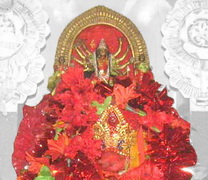
Attahas is one of the many Shakti Peeths spread across the Indian subcontinent and one of the most important in Bengal. The word attahas means “loud laughter”, a reminder of the mighty, fearless laughter of the Divine Mother.
After Sati gave up her life at the yagna of her father Daksha, Lord Shiva danced the Tandava in grief and rage with her body on his shoulders. To calm him and save creation, Lord Vishnu divided the body with his Sudarshan Chakra. At Attahas, Sati’s lower lip is believed to have fallen.
Location
The Shakti Peeth is in Birbhum district of West Bengal, a short distance east of the town of Labhpur. It is easy to visit from Kolkata, and the area around Birbhum is rich in Shakti shrines – Tarapith, Nalhati, Bakreshwar and Kankalitala are all in the same region.
The Goddess & Bhairava
The Goddess is worshipped here as Phullara (or Fullara), “the blooming one”, because she is ever cheerful and full of grace. Lord Shiva as Bhairava is called Vishwesh, the Lord of the Universe. A special feature of this place is that the shrine of Bhairava stands right beside the temple of the Goddess, so both can be worshipped together.
Devotees offer anna-bhog (cooked rice offerings), fruits and flowers to the Goddess, and the temple is surrounded by a calm, green landscape that is ideal for prayer and meditation.
Interesting Facts
Next to the temple is a large pond with a beautiful legend. It is said that when Lord Rama prepared to worship Goddess Durga before his battle with Ravana, he needed 108 blue lotuses. Hanuman collected the lotuses from this very pond and brought them to Sri Ramachandra for the puja. Devotees still treat the pond as sacred.
Because of its name and its legend, Attahas is believed to be a place where the Goddess removes sorrow and fills her devotees’ lives with joy.
Festivals & Worship
The most important celebrations at the Phullara Devi temple are Durga Puja and Sharad Navaratri in September–October, when the temple is decorated and special pujas and bhog are offered every day. The nine days of Chaitra (Vasanta) Navaratri in March–April are also observed with great devotion, along with Kali Puja on the new-moon night of Diwali.
Spiritual Significance & Visiting Tips
The lips are the gateway of speech and of joy. Devotees believe that Maa Phullara blesses those who pray here with sweet, truthful words, a cheerful heart and freedom from quarrels at home. Many families visit before weddings and other happy occasions to seek her blessing, and the anna-bhog offered at noon is shared with visitors as prasad.
The temple is in a rural setting, so it is best to visit during the day and to combine it with other shrines of Birbhum in a single trip. Bolpur and Shantiniketan, with the university founded by Rabindranath Tagore, make a pleasant base for a two- or three-day pilgrimage circuit of the region. Dress modestly, remove footwear before entering the shrine, and follow the instructions of the priests. Simple offerings such as flowers, fruit, vermilion, a red chunri and incense are traditional, and it is good practice to buy them from the stalls near the temple, which also supports local families.
How to Reach & When to Visit
Travellers usually reach Ahmedpur or Labpur railway station and continue by road; Labhpur is about 10 km (6.5 miles) from Ahmedpur, and the temple lies a little east of the town. Bolpur–Shantiniketan, the nearest large town, has hotels and makes a good base. The cool months from October to March are the most comfortable for a visit.