Names & Legend
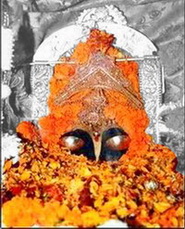
Jwalamukhi is one of the most famous Shakti Peeths, where the Goddess is believed to be visibly present and active. Jwala means “flame” and mukhi means “mouth” – she is the goddess whose mouth is fire. Instead of an idol, she is worshipped in the form of flames that rise naturally from the rock.
When Lord Shiva carried the body of Sati in grief, Lord Vishnu divided it with his Sudarshan Chakra. At Jwalamukhi, Sati’s tongue is believed to have fallen – and it is said that this is why the Goddess appears here as tongues of fire.
Location
The temple is in the town of Jawalamukhi in the Kangra district of Himachal Pradesh, about 30 km south of Kangra town, set against the foothills of the Dhauladhar range.
The Goddess, the Flames & Bhairava
The Goddess is worshipped as Siddhida, “the giver of spiritual powers”, also called Ambika, and Lord Shiva is worshipped as Unmatta Bhairava. According to the scriptures, the flames inside the sanctum burn continuously without any fuel.
The nine flames are worshipped as nine forms of the one Goddess: Mahakali, Annapurna, Chandi, Hinglaj, Vindhyavasini, Mahalakshmi, Saraswati, Ambika and Anjana (Anji Devi). Priests offer milk, sweets and prayers to the flames several times a day, and the evening aarti is a moving sight.
Interesting Facts
A well-known story tells that the Mughal emperor Akbar tried to put out the flames by covering them with iron sheets and channelling water over them, but the flames kept burning. Humbled, he offered a golden umbrella (chhatra) to the Goddess, which is said to have turned into an unknown metal; it can still be seen at the temple. The temple’s gilded dome was later offered by Maharaja Ranjit Singh.
A short walk away is Gorakh Dibbi, a small pool where the water appears to boil while it is actually cool – linked with the saint Guru Gorakhnath. Tradition holds that the temple has been worshipped since ancient times, when the gods themselves walked the earth.
Festivals & Worship
Large fairs are held during the Chaitra and Sharad (Ashvin) Navaratri, when lakhs of devotees from Himachal, Punjab and across North India come for darshan. Pilgrims often combine Jwalamukhi with the nearby goddess temples of Chintpurni, Brajeshwari (Kangra), Chamunda and Naina Devi.
How to Reach & When to Visit
The nearest airport is Gaggal (Kangra), about 50 km away. The nearest broad-gauge railhead is Pathankot, and the scenic narrow-gauge Kangra Valley railway stops at Jawalamukhi Road. Buses run from Delhi, Chandigarh, Dharamshala and Shimla. The temple can be visited all year; March to June and September to November are the most comfortable seasons.