Names & Legend
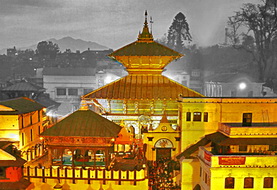
To know the Pashupatinath Shakti Peeth, one must visit the Guhyeshwari temple, the name by which this seat of the Goddess is known. It is one of the most sacred Shakti Peeths in Nepal and has a long and vivid history.
When Lord Vishnu divided Sati’s body with his Sudarshan Chakra as Lord Shiva carried it in grief, both of Sati’s knees are believed to have fallen here. The name Guhyeshwari comes from guhya, “secret” or “hidden”, and guha, a cave – the shrine was once a hidden cave in the forest, and the Goddess is worshipped in a secret form.
Location
The temple is in Kathmandu, on the bank of the holy Bagmati river, about a kilometre east of the great Pashupatinath temple. Together, the two temples form the most important pilgrimage of Nepal, deeply revered by the local people and by devotees from India and around the world.
The Goddess & Bhairava
The Goddess is worshipped as Mahamaya, the great power of illusion, and Lord Shiva as Bhairava is called Kapali, “the bearer of the skull”. There is no idol: in the centre of the temple, the Goddess is worshipped as a sacred pit of water covered by a golden kalash (pot). The temple was built in its present form in the 17th century by King Pratap Malla, in the Bhutanese pagoda style, with an open courtyard and a gilded canopy of serpents.
It is a tradition to visit Guhyeshwari first and then Pashupatinath, honouring Shakti before Shiva.
The Legend of Pashupati
According to legend, after the loss of Sati, Lord Shiva wandered in sorrow and came to the forest beside the Bagmati, known as Mrigasthali. Delighted by its beauty, he took the form of a deer and roamed there, hidden from the gods. Parvati – Sati reborn – was worried to see her husband alone in the forest and wished always to remain by his side, for he had already suffered the loss of his wife at Daksha’s yagna. The gods found Shiva and broke one of his horns, which became the lingam later worshipped as Pashupatinath, “the Lord of all beings”.
Festivals & Worship
Dashain (Navaratri) is the greatest festival at Guhyeshwari, when thousands of devotees come to worship the Goddess. Teej, when women fast and pray for their husbands, and Maha Shivaratri, when Pashupatinath fills with sadhus from across South Asia, are other great occasions. Note that only Hindus (and Buddhists) are allowed inside the main shrines.
How to Reach & When to Visit
Kathmandu’s Tribhuvan International Airport is very close to the temples. Indian pilgrims can also travel by road through the border crossings at Raxaul–Birgunj or Sunauli–Bhairahawa; Indian citizens do not need a visa for Nepal but should carry a valid ID. The best time to visit is from October to April, especially during Dashain or Shivaratri.