Names & Legend
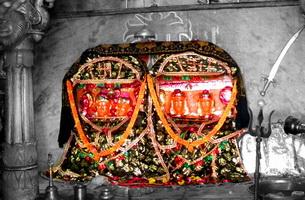
Pushkar is famous all over the world as a destination for travellers, but for devotees it is first of all a tirtha – one of the holiest places in India – and the home of the Manivedika Shakti Peeth, also called Manibandh.
When Lord Vishnu divided Sati’s body with his Sudarshan Chakra as Lord Shiva carried it in grief, a part fell at Pushkar. There are two opinions about which part: many religious teachers say both of Sati’s wrists fell here (manibandh means wrist), while others say it was the middle of her palms. Either way, the hands that bless are honoured here.
Location
The Shakti Peeth is in Pushkar, in the Ajmer district of central Rajasthan, about 15 km from Ajmer. The temple of the Goddess stands on a hill near the town, from where there is a wide view of the holy lake, the white temples and the desert hills around.
The Goddess & Bhairava
The Goddess is worshipped as Gayatri, the mother of the Vedas; some devotees also worship her as Saraswati. Lord Shiva as Bhairava is called Sarvananda, “the one who makes everyone happy”. Many devotees also climb Ratnagiri hill to the temple of Savitri, the first wife of Lord Brahma.
The Legend of Pushkar
According to the Padma Purana, Lord Brahma dropped a lotus flower here, and where its petals fell, lakes appeared – giving the place its name, from pushpa (flower). Brahma then held a great yagna at Pushkar. When his wife Savitri was late, he married Gayatri so that the ritual could be completed. Angered, Savitri cursed Brahma that he would be worshipped only at Pushkar. That is why the Brahma Temple of Pushkar is one of the very few temples of Lord Brahma in the world.
Interesting Facts
The sacred Pushkar lake is surrounded by 52 ghats, and a bath in it, especially on Kartik Purnima, is believed to wash away sins. The town follows the culture and traditions of Rajasthan in every way – from its music and colourful markets to its strict customs: Pushkar is a vegetarian town where meat, eggs and alcohol are not allowed.
Festivals, Travel & When to Visit
The world-famous Pushkar Mela is held in the month of Kartik (October–November), ending on Kartik Purnima; it combines a great religious bathing festival with one of the largest camel and livestock fairs in the world. Navaratri is celebrated at the Goddess’s temple. The nearest railway station is Ajmer Junction, and the nearest airports are Kishangarh and Jaipur (about 150 km). The best time to visit is from October to March.