Names & Legend
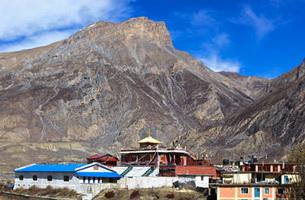
The body of Sati fell at many places across the Indian subcontinent, and Nepal is home to some of the most important Shakti Peeths. One of them is the Gandaki Shakti Peeth, named after the holy Gandaki river.
When Lord Shiva danced the Tandava with Sati’s body after her self-sacrifice at Daksha’s yagna, Lord Vishnu divided it with his Sudarshan Chakra. At Gandaki, Sati’s right cheek is believed to have fallen (some lists say her temple, the side of the forehead).
Location
The Shakti Peeth is at Muktinath, in the Mustang district of Nepal, high in the Himalayas at an altitude of about 3,700 metres. It lies near the upper valley of the Kali Gandaki river, surrounded by the dramatic, wind-swept landscape of the Annapurna and Dhaulagiri ranges. Hindus call the place Muktikshetra, “the place of liberation”.
The Goddess & Bhairava
Local devotees worship the Goddess as Gandaki Chandi, the fierce mother who removes every obstacle on the path of her devotees. Lord Shiva as Bhairava is called Chakrapani, “the one who holds the discus”. It is believed that any sincere wish is fulfilled when one prays to the Goddess here with devotion.
The main Muktinath temple is dedicated to Lord Vishnu. Behind it, 108 water spouts shaped like cow heads pour ice-cold water, and pilgrims bathe under every one of them. Nearby, in the Jwala Mai temple, a natural flame of gas burns over flowing water – a rare meeting of fire and water.
Interesting Facts
The Kali Gandaki is the source of the sacred Shaligram stones – black fossil stones worshipped in homes and temples as a form of Lord Vishnu. According to the Puranas, Vrinda (Tulsi), the devoted wife of the demon Jalandhara, cursed Lord Vishnu to become a stone, and he took the form of the Shaligram in this river. Tulsi in turn became the holy basil plant, and since then Tulsi is always worshipped together with the Shaligram.
Muktinath is holy to Buddhists as well, who call it Chumig Gyatsa, “a hundred waters”, and believe that Guru Padmasambhava meditated here. Hindu priests and Buddhist nuns serve at the shrines side by side.
Spiritual Significance
The name Muktinath means “the Lord of liberation”, and Hindus believe that a pilgrimage here helps free the soul from the cycle of birth and death. Bathing under the 108 spouts is said to wash away the sins of 108 lifetimes, and worshipping Gandaki Chandi beside them is believed to remove the obstacles that stand in the way of the seeker.
Muktinath is also one of the 108 Divya Desams, the most sacred temples of Lord Vishnu praised by the Alvar saints, which makes it holy for Vaishnavas as well as Shaktas. Its meeting of Hindu and Buddhist worship, of fire and water, and of mountain and river makes it a powerful symbol of the unity behind all forms of the divine.
Visiting Tips
Carry warm clothes, a windproof jacket, sun protection and enough cash, as facilities in the mountains are limited. Do not rush the ascent; spend a night at Jomsom or Kagbeni to acclimatise. Dress modestly, remove footwear before entering the shrine, and follow the instructions of the priests. Simple offerings such as flowers, fruit, vermilion, a red chunri and incense are traditional, and it is good practice to buy them from the stalls near the temple, which also supports local families.
How to Reach & When to Visit
Indian pilgrims usually enter Nepal at Sunauli–Bhairahawa or another border crossing and travel to Pokhara. From Pokhara, small flights go to Jomsom, from where a jeep or trek leads to Ranipauwa village below the temple; the whole journey can also be made by road. The best seasons are March to June and September to November. Winters are bitterly cold, and the altitude requires visitors to take it slowly and stay well hydrated.