Names & Legend
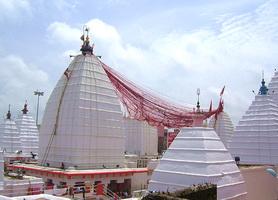
The Deoghar Shakti Peeth is better known as Baidyanath Dham. It is one of the most important Hindu pilgrimages in India, because it is both a Shakti Peeth of the Goddess and one of the twelve Jyotirlingas of Lord Shiva. The name Deoghar itself means “the home of the gods”.
When Lord Shiva roamed the universe carrying the body of Sati, Lord Vishnu divided it with the Sudarshan Chakra. At Deoghar, Sati’s heart is believed to have fallen, and so the place is also called Hridaya Peeth, “the seat of the heart”. Because Shiva and Shakti are worshipped together here, the temples of the Goddess and of Lord Baidyanath are tied together with sacred red threads.
Location
Baidyanath Dham is in the town of Deoghar, in the Santhal Pargana region of Jharkhand. The area was part of Bihar until Jharkhand was formed in 2000. The nearest railway junction is Jasidih, about 7 km away.
The Goddess & Bhairava
The Goddess is worshipped here as Jaya Durga, the victorious mother. Lord Shiva is worshipped as Vaidyanath (also pronounced Baidyanath), “the Lord of physicians”, who heals the illnesses of body and mind.
A famous legend tells how the demon king Ravana pleased Lord Shiva and was allowed to carry a lingam to Lanka on the condition that he would not set it down on the way. Through the play of the gods he was forced to put it down at Deoghar, where it remained forever. Shiva also healed Ravana here, which is why he is called Vaidyanath.
The Temple
The main temple of Baidyanath is the most important temple in Jharkhand. It is a plain, white, ancient structure about 72 feet tall, surrounded by about twenty smaller temples dedicated to other deities. Its top carries three gold vessels offered by the Maharaja of Gidhaur and, unusually, a Panchashool (a five-pointed trident) instead of the usual single trident. Inside the spire is an eight-petalled lotus jewel called the Chandrakanta Mani.
The lingam is cylindrical, about 5 inches in diameter, and rises about 4 inches from the centre of a large basalt slab. Its top is uneven, and no one knows how deep the lingam goes below the ground.
Festivals & Worship
Deoghar is world-famous for the Shravani Mela, held every year during the holy month of Shravan (July–August). Millions of devotees, called Kanwariyas, dressed in saffron, collect holy water from the Ganga at Sultanganj and walk barefoot about 105–108 km to offer it on the lingam, chanting “Bol Bam!”. The unbroken line of pilgrims is one of the largest religious gatherings in the world. Maha Shivaratri and Navaratri are also celebrated with great devotion.
Spiritual Significance
Deoghar is called the Hridaya Peeth because the heart is the centre of love, devotion and life itself. It is believed that prayers offered here go straight to the heart of the Mother, and that Lord Vaidyanath heals not only diseases of the body but also sorrow and fear.
Since Shiva and Shakti are worshipped side by side, married couples often visit together to pray for a long and loving partnership, and the custom of tying sacred threads between the two temples symbolises this unbreakable bond.
Visiting Tips
During the Shravani Mela the crowds are enormous, so plan accommodation well in advance and be prepared for long queues. At other times, early morning is the quietest hour for darshan. Dress modestly, remove footwear before entering the shrine, and follow the instructions of the priests. Simple offerings such as flowers, fruit, vermilion, a red chunri and incense are traditional, and it is good practice to buy them from the stalls near the temple, which also supports local families.
How to Reach & When to Visit
Trains run to Jasidih Junction on the Howrah–Delhi main line, and also to Deoghar station. Deoghar Airport has flights from major cities. The town is well connected by road to Patna, Ranchi and Kolkata. Visit during Shravan to experience the Shravani Mela, or from October to March for a quieter, more comfortable darshan.